



Engaging multilingual learners in mathematics
By: Hannah Haynes
If you teach mathematics, you may not think of yourself as a language teacher, but every math lesson is, in part, a language lesson. Students don’t just learn math facts and procedures, they also learn to talk about those facts and procedures, calculate quantities, explain their reasoning and make sense of someone else’s approach. For multilingual learners, the content of mathematics and the language for mathematics are connected, and understanding how to support both at once is one of the best things a math teacher can do.
With the help of WIDA experts Alisa Rhoads and Melissa Paton, this article provides answers to common questions math teachers ask about supporting multilingual learners and offers concrete, classroom-ready strategies you can start using right away.
A language-rich discipline
It’s easy to think of math as a subject built on numbers and formulas, separate from reading, writing and talking. But in reality, students learn math through purposeful engagement and talk. Making sense of a problem, comparing strategies and justifying an answer are all collaborative, language-driven processes.
“One common misconception is that you need to wait until a student is fluent in English for them to learn math or show what they know,” said Alisa Rhoads, a WIDA professional learning facilitator and former math instructional coach.
Instead, think of learning math and learning language as interwoven. They happen simultaneously. An effective and welcoming math classroom positions all learners to share their thinking, even when it may be delivered with simple language, gestures or drawings.
The language needed for math
Multilingual learners draw on and move fluidly through a wide variety of language resources to engage with math:
- Everyday, informal language
- Classroom “shorthand,” such as shared terms and phrases your class has built together
- Home languages
- Precise, academic language
All of these are legitimate entry points into a math task, and all of them can lead to deep mathematical thinking. Precise academic language is a goal to build over time, not a prerequisite for participation.
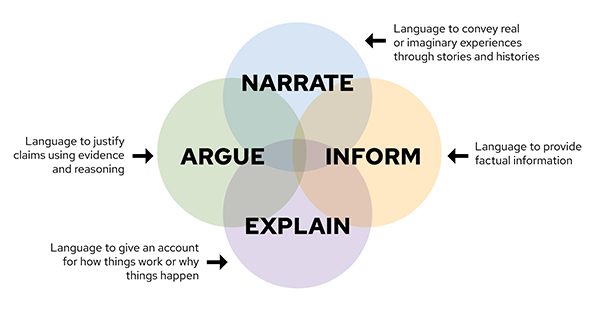
Before you can support students’ language development in math, it helps to know what language a given task requires. The WIDA English Language Development (ELD) Standards Framework, 2020 Edition, highlights four Key Language Uses (KLUs) that students use in mathematics classrooms across grade levels: Narrate, Inform, Explain and Argue.
The graphic below shows the four Key Language Uses – Narrate, Inform, Explain, Argue – inside four overlapping circles. This overlap demonstrates the intersectionality of the most prominent language uses across disciplines. Each circle has a description of the language next to it. For Narrate: Language to convey real or imaginary experiences through stories and histories. For Inform: Language to provide factual information. For Explain: Language to give an account for how things work or why things happen. For Argue: Language to justify claims using evidence and reasoning.
“The language genres of Argue and Explain are critical in mathematics. Students need to be able to defend resolution strategies and explain not only why their strategy works but how it connects to efficient resolution,” said Melissa Paton, a WIDA professional learning facilitator.
A useful starting point is actually your end-of-unit task. Ask: What KLU will students use to demonstrate their understanding of this content standard? Once you have determined which KLU will be most appropriate to demonstrate students’ knowledge at the end of the unit, you can identify which language features students will need to practice during instruction. For example, if students will be asked to Argue a position, they may need practice with the following language features:
- Connectives to sequence (first, second, all in all)
- Connectives to contrast (instead, however, yet, on the other hand)
- Modal verbs to convey certainty (may, might, must, should, will)
The KLUs help prioritize and organize curricular planning for content and language integration. Learn more about them:
- WIDA grade-level cluster materials
- WIDA Self-Paced Workshop: Making Language Visible in the Classroom: Explore the Key Language Uses
Strategies and approach
There are many ways to engage students in content. Look for opportunities in lessons where students can demonstrate their learning in multiple ways. For example:
- Open-ended tasks with more than one correct answer or approach
- Problems that can be solved with multiple strategies
- Opportunities for students to show understanding through more than words alone, such as drawing or modeling
To support students in generating ideas and questions, plan for them to have more thinking time, especially before asking them to share out in a group conversation, Alisa suggested.
She recommends planning ways to model patience, persistence and acceptance, which will set the tone for students in their conversations about mathematics with one another.
Small-group discussions and problem-solving are especially productive for language development and offer the following advantages:
- More contextualized language: Multilingual learners hear language tied directly to a shared, immediate purpose in a lesson.
- More turns, more ownership: Students get more chances to talk and take on responsibility to clarify their meaning without relying on the teacher to mediate.
- More repetition, more modes: Concepts are often repeated during small-group discussions, and sharing ideas can involve talking, drawing and demonstrating.
Using visuals, gestures and the classroom environment as resources can also be powerful. Consider ways to use the following:
- Students’ own experiences, knowledge and assets, including their home languages
- Peers and teachers as talk partners
- Physical resources in the classroom, such as charts, manipulatives and visuals
- Familiar classroom “shorthand” and gestures
- Communication strategies like drawing, modeling and demonstrating
Students learn best when they are truly listened to and their ideas are taken seriously. This is essential not just for multilingual learners but for all learners. A supportive classroom culture goes a long way. Create an environment where students can ask questions, propose ideas and make mistakes. Encourage every student to be a source of ideas, and let them know their contributions are examined and valued.
Tying it all together
Multilingual learners don’t need to master English before they can practice rich mathematical thinking. Instead, they need classroom tasks designed with various language entry points, a classroom culture of small-group talk, ample visual supports and a teacher who believes that every student has something worthwhile to contribute. When you plan for language needs the same way you plan for content standards, you create a math classroom where all students can engage at a high level in whatever language gets them there.

Connect with WIDA
Learn about the latest resources, exchange ideas and engage in discussion.


