

What multilingual learners with disabilities can do: Shifting from myths to meaningful support
By Emily Kurth
Have you ever heard that using two languages is too confusing for multilingual learners with disabilities, so it is better to focus on English only? Or, that students who do not use spoken language cannot communicate meaningfully? These two ideas are harmful myths about how multilingual students learn and grow. Debunking these falsehoods with asset-based approaches and research-based strategies is key to both the academic success and socio-emotional development of multilingual learners with disabilities.
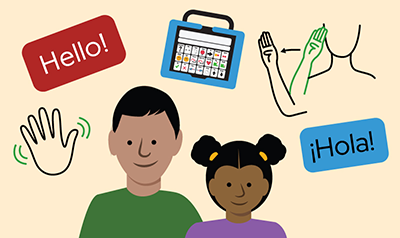
Multilingual learners with disabilities can successfully develop and use multiple languages as there is no evidence proving bilingual instruction is too confusing (Soto & Yu, 2014; Padía, 2025). All multilingual learners, including those who use spoken language and those who communicate in other ways, can develop language when given access to the tools, supports and opportunities they need to express themselves authentically and fully, which includes drawing upon their home language or languages (Padía, 2025). In addition to affirming home language use, implementing an asset-based approach to teaching multilingual learners with disabilities requires educators to reflect upon their preexisting notions of what counts as communication. Normalizing and uplifting students' diverse forms of communication — meaning all the different ways they share and understand ideas, such as sign language, gestures, assistive tools and more — not only cultivates a sense of belonging, but provides equal access to academic opportunities.
The new WIDA Self-Paced Workshop, Supporting Multilingual Learners With Disabilities in Language and Communication, equips educators with research-based strategies, classroom-ready resources and actionable tools to foster inclusive learning environments. Explore key ideas from this workshop through the following three reflection questions and discover practical ways to turn asset-based beliefs into applicable classroom practices:
1. Does the language I use to describe students reflect what I believe they can do?
- It can be easy to overlook deficit-based language in our desire to plainly state students’ needs. However, asset-framing is critical as the language we use shapes how students are perceived. For example, consider reframing phrases like “struggles to communicate,” or “doesn’t have much language,” to what we do know about a student and what we can perceive from their communication. Using phrasing such as “communicates in ways other than vocal speech through the use of gesturing and pointing,” or “is mostly nonspeaking, and shows understanding in English and Spanish through facial expressions and sounds,” promotes can-do beliefs while modeling strength-based language for others. Our self-paced workshop explains why the way we speak about disabilities matters.
2. Do I carry over communication practices from students’ home environments to school settings?
- Parents and caregivers have deep knowledge of their children's strengths, preferences and daily communicative practices. Families who use diverse methods to communicate can offer especially valuable insights that help educators design language development opportunities that connect to students' everyday experiences and familiar strategies. These conversations may identify approaches we have not considered, helping us move beyond personal interpretations and better understand the established (and often unseen) practices used at home. Start by reaching out to families with the sole purpose of listening and learning about how communication looks at home and in the community. Try asking “How does your child communicate needs and wants?” as this may capture both home language use and preferred communication styles (Deniz et al., 2026). The self-paced workshop contains a new caregiver guide with questions, interview snapshots and classroom connections. Additionally, the WIDA webpage Building Trust in action has ideas and ready-to-use resources to support your efforts in building relationships with caregivers.
3. Have I taught students how to interact meaningfully using the communication methods of their peers?
- School, language learning and communication are inherently social practices, so multilingual learners with disabilities need to interact meaningfully with peers to thrive. This begins with educators explicitly teaching classroom communities about the diverse communication methods their peers use and integrating them into classroom routines and learning activities. This modeling illustrates to students that learning can happen through all forms of communication, including speech, gestures and other methods. By developing interactions that explicitly teach students how to interpret and express information using methods beyond vocal speech, we build a sense of belonging amongst peers and enrich the communication practices of all members in the classroom community. Wondering what this looks like in practice? Our self-paced workshop features Marcus, a multilingual learner who uses vocal speech alongside an augmentative and alternative communication (AAC) device. Through classroom videos, teacher reflections and lesson artifacts, educators can see how Park View Elementary in Glen Ellyn, Illinois, creates opportunities for students to communicate, connect and learn from one another by honoring all forms of communication.
As Dr. Lilly Padía (2025) reminds us, “until we have communication systems, knowledge, and structures in place to support multiple forms of communication, we will miss so much of what our children have to share” (p. 19).
Ready to learn more and put these ideas into action? Enroll in the Supporting Multilingual Learners With Disabilities in Language and Communication WIDA Self-Paced Workshop and receive access to practical strategies, real classroom examples and instructional tools at your fingertips. Get started here:
Log in to your WIDA Secure Portal account.
Don’t have an account yet? Visit your member/state page on the WIDA website to learn how to create one.
Questions? Contact the WIDA Client Services Center at help@wida.wisc.edu or 1-866-276-7735.
About the Author
Emily Kurth is a professional learning curriculum specialist in WIDA’s Educator Learning, Research and Practice team. In this role, she engages in the research, development and facilitation of WIDA’s professional learning with educators of multilingual learners across the consortium.
References:
Deniz, F. K., Antill, K., & Spies, T. G. (2026). Funds of knowledge: Enhancing culturally sustaining practices for multilingual learners who are autistic. Intervention in School and Clinic, 61(3), 121–132. https://doi.org/10.1177/10534512251390427
Padía, L. (with Souto-Manning, M.). (2025). Teaching beyond spoken words: Communicating with bilingual nonspeaking children in the classroom. Teachers College Press.
Soto, G. & Yu, B. (2014). Considerations for the provision of services to bilingual children who use augmentative and alternative communication. Augmentative and Alternative Communication, 30(1), 83–92. https://doi.org/10.3109/07434618.2013.878751
Connect with WIDA
Learn about the latest resources, exchange ideas and engage in discussion.


