


Looking back at the 2026 WIDA Annual Conference
By Hannah Haynes
Every fall, the WIDA Annual Conference brings together educators from across the country around one goal: serving multilingual learners as well as we possibly can. It’s a conference by teachers, for teachers with dozens of sessions led by the practitioners doing the work every day.
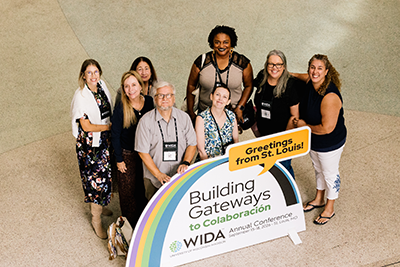
This year, that work happened in St. Louis, Missouri, from September 16 to 18 under the theme “Building Gateways to Colaboración.” And collaboration didn’t just show up in the title; it ran through nearly every session on the schedule, from the opening keynote to the very last breakout session.
Setting the tone, virtually and in person
The conference opened with the curated virtual track before anyone set foot in St. Louis. In the virtual keynote, Andrea Honigsfeld, a professor emeritus in the School of Education and Human Services at Molloy College, spoke about the power of collaboration.
“My entire life is summed up with the overarching goal: how to create more cohesive school communities for all learners,” Honigsfeld said. “Let’s break down silos. No more my kids, your kids. All kids belong to everybody.”
When the in-person conference kicked off, WIDA Executive Director Dr. Jenni Torres grounded the room in that same theme, reminding attendees that this work can’t be done alone. She then introduced keynote speaker Cristina Henríquez, author of the widely acclaimed novel The Book of Unknown Americans and, most recently, The Great Divide.
Henríquez delivered a powerful keynote centered on community—creating it, nurturing it and showing up for it. She told the room of educators, “Every single day you are doing the work of creating communities. You are building gateways and holding them open for people to walk through."
She walked the audience through her own life story: a father who immigrated from Panama, a mother from Delaware and a childhood spent finding friends and building belonging across seven different states and nine different schools. It was a message that landed squarely with a room full of educators who so often work with students who are new to the country, new to the school and new to the community and many of whom were once newcomers themselves.
Henríquez closed with a challenge: Keep building communities, in places you’d expect and in places you may not. “Expand your definition and understanding of community,” she said.
In all, more than 1,600 educators attended in person this year, joined by nearly 900 more through WIDA’s virtual track.
Two major highlights
Sitting in session after session, two things stood out above the rest: how much of the conference was led by educators themselves and how consistently sessions pulled content-area teachers and language teachers together.
That pairing was front and center in “Centering WIDA and NGSS for Multilingual Science Learning,” led by WIDA founder Dr. Tim Boals, Dr. Okhee Lee and New York science teacher Iovanna Williams. The presenters, speaking to a room that included several science teachers, made the case that rigorous content standards and rich science content aren’t in tension, they reinforce each other.
“The best way to learn language is through content,” Boals said.
Williams put a finer point on it: “It is not necessary for multilingual learners to know the academic language in order to engage and understand the content.” The session laid out just how tightly the Next Generation Science Standards (NGSS) and the WIDA English Language Development (ELD) Standards already align.
Dr. Kate Kinsella’s session, “Collaborating Across Content Areas to Implement Schoolwide ELD Instructional Routines,” tackled the same idea from a different angle. Kinsella tried to make collaboration feel less like a mountain to climb. She encouraged attendees to break it into smaller, more manageable pieces rather than treating it as one overwhelming initiative.
“We should emphasize the listening part of collaboration more,” she said. “Don’t just talk, but listen, really listen to what a colleague is saying.”
Literacy as a lifelong journey
The Wisconsin Idea, the notion that education at the University of Wisconsin–Madison (WIDA’s home) should serve the public well beyond its classroom and even the state of Wisconsin, is always prominent at the conference. One of the best examples was the session “Literacy for All: Centering Multilingual Learners,” a panel led by Dean Marcelle Haddix and Jenni Torres, featuring several expert educators.
“You’re not just teaching kids to read and write,” Dean Haddix told the room. “You’re teaching them to be a reader and a writer.”
Haddix and her fellow panelists pushed attendees to think of literacy not as something tied to a single grade or moment but as a journey that stretches across a person’s entire life. Once again, the throughline was shared responsibility: The panel was clear that every educator is a literacy teacher, which means collaboration across roles isn’t optional, it’s essential.
Standing room only
A particularly notable session was “Co-Planning, Co-Teaching, Co-Learning: Using the WIDA ELD Standards Together,” presented by Lauren Bartholomae, a WIDA professional learning curriculum specialist, and her collaborator, educator Amanda Goddard. The room was packed and for good reason. The session gave educators concrete ways to put the WIDA ELD Standards into practice together, rather than in separate silos.
If you missed it, you’re in luck: The session built on a WIDA Webinar that’s freely available on our website.
Closing keynote
The week closed with a keynote from Diep Nguyen, whose work has shaped multilingual education for educators across the WIDA Consortium and beyond. Nguyen shared her own story of arriving in the United States as a refugee from Vietnam in the 1970s and starting school here with little English. Nguyen is, in many ways, a living picture of the students so many attendees have in their classrooms right now. Her story was a fitting way to end the conference, by bringing it all back around to the students themselves.
Looking ahead to 2027
For anyone who couldn’t catch everything live, session recordings will be available starting October 12, 2026.
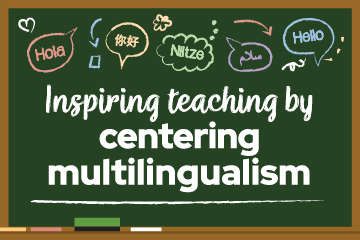
And mark your calendars: The 2027 WIDA Annual Conference heads to Philadelphia, Pennsylvania, from October 19-22, 2027, with a curated virtual track once again for those joining remotely. Next year’s theme, “Inspiring teaching by centering multilingualism,” feels like a natural next chapter after a conference so grounded in collaboration. Interested in presenting? The call for proposals opens November 16, 2026, and runs through January 20, 2027. Learn more and find registration details on the 2027 WIDA Annual Conference website.

Connect with WIDA
Learn about the latest resources, exchange ideas and engage in discussion.


