



Effective classroom assessments can be designed to recognize and build on what multilingual students already do well.
This is the second of a three-part WIDA Snapshot series on classroom assessment that looks at how teachers can: create connected learning goals, use feedback effectively, and enhance their assessment literacy.
This Snapshot highlights the power of teacher, peer and self-reflective feedback in elevating multilingual learners’ voices and building relationships.
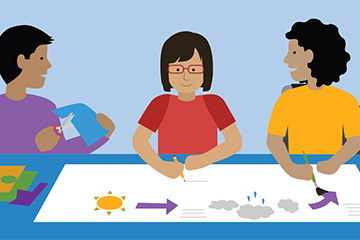 The third-grade unit on weather patterns is underway at Curie Elementary. Students are well-versed in their integrated learning objectives, and, with teacher guidance, they have converted the objectives into “What I can do” statements for each lesson. During the week, the class is introduced to examples of useful feedback — what it is, who is involved and how to use it productively.
Teachers at Curie have explored feedback as an essential component of classroom assessment. They realize that feedback on standards-aligned, content-driven language offers useful information to students and teachers while also helping to build relationships that strengthen the classroom community. Likewise, specific and actionable feedback serves as a barometer for estimating students’ movement toward meeting their integrated learning objectives or integrated learning targets. During co-planning time, the third-grade teacher team identifies ways to gather information through observation and interaction to make the most of feedback from three sources: teachers, classroom peers and individual students.
Teacher Feedback
Just like instruction, feedback is most effective when it is multimodal. That way, students can experiment with multiple ways to show what they know, and teachers can offer a variety of modalities to facilitate communication. For example, in their unit on weather, the third-graders are invited to use gestures to show differences in daily temperatures, ask and answer oral questions, or create a data table to contrast daytime high and nighttime low temperatures. Teacher feedback in this instance reflects the integrated learning objective: “Students will collect daytime high and nighttime low temperatures for their locations.”
Here are some ideas for teacher-student feedback for the lesson that emphasize what the student produces.
Gestural feedback: “Let’s use our hands to show temperature. First, point to one of your two locations or places. That’s good, let’s start with Guangzhou, China. Then, for each day of the week, show me the higher temperature with this hand (the right one). Show me the lower temperature with your other hand (the left one). Choose a day of the week, and we’ll do the first one together.”
Oral feedback: “Let’s look at the temperatures for the week (or for a certain day). Tell me how you know that one of your places is warmer. What is the difference between the warmest and the coolest temperature? How did you figure that out?”
Written feedback: “Look at your chart. There should be seven days and seven nights in a week or 14 temperatures altogether. Put a circle around the hottest day and a square around the coldest night. Then, in three or four sentences, describe the pattern of temperatures for one of your places in your notebook.”
Peer Feedback
In preparing to give feedback, the third-grade team redoubles its effort to create a warm and welcoming classroom environment where all students feel safe (Jose, 2026). The teachers ensure that multilingual learners feel comfortable accessing and using all their languages, including through opportunities for translanguaging. They also make sure that students’ languages and cultures are represented in the classroom, and maintain a classroom policy where multilingualism is the norm (Gottlieb, 2021).
Once students are familiar with teacher feedback, peer feedback reinforces the classroom assessment routine. Beginning with modeling and paired practice, teachers share with students why feedback is helpful, what it looks like and how to respectfully respond. Having concrete success criteria grounded in the integrated learning objective for each lesson paves the way to favorable and useful feedback between two students, either orally or in writing, leading to increased student confidence and agency.
Student Self-Reflection
Feedback can also take the form of student self-assessment. Since learning is personalized, students need time to nurture their thoughts and reactions, build their metacognition, and become comfortable with engaging in self-evaluation. As a prelude to oral or written reflection, teachers might initiate a two-minute pause, inviting students to stop, process and make personal connections to new knowledge or experiences in the lesson. Additionally, it can be a time for students to engage in cross-linguistic transfer.
Toward the end of the weather unit, third-graders are to explain why weekly temperatures differ (or not) and relate their experience in an oral or written summary. Students begin by thinking about weather patterns they are familiar with. To guide self-reflection, the teacher and students might co-create a checklist or list of questions, in this instance centered around explanation, such as
- “Why do you think the temperatures change or don’t change in your location? Give an example.”
- “How does the weather change or not change in your location?”
Conclusion
The following table presents different types of feedback that may be given during instruction for the third-grade unit described in this Snapshot. The examples provided are dependent on the nature of the classroom relationship (teacher-student, student-student or student self-reflection) and are centered around a common integrated learning objective.
Table 1: Types of Feedback Given During Instruction
| Third-Grade Integrated Learning Objective | Classroom Relationship | Example of Feedback Given During a Lesson |
|---|---|---|
| Students will collect daytime high and nighttime low temperatures for their locations. | Teacher–student | Gestural feedback based on a student conversation with their teacher (e.g., “Show me the temperature on the thermometer.”) |
| Students will collect daytime high and nighttime low temperatures for their locations. | Student–student (peer) | Oral feedback based on criteria for success (comparing temperatures) during interaction with pairs or small groups (e.g., “The low in Accra, Ghana, on March 22 was 79 degrees Fahrenheit or 26 degrees Celsius.”) |
| Students will collect daytime high and nighttime low temperatures for their locations. | Student self-reflection | Written feedback in response to data collection (e.g., “Where did you look? How did you record your temperatures?”) |
Clear, helpful feedback can strongly influence teaching and learning practices and serve as a powerful classroom assessment tool for students and teachers. It offers a means of fortifying teacher-student and student-student relationships while encouraging student introspection (Gottlieb, 2024). In essence, feedback, as the heart of classroom assessment, fortifies student learning.
References
Gottlieb, M. (2024). Assessing multilingual learners: Bridges to empowerment (3rd ed.). Corwin.
Gottlieb, M. (2021). Classroom assessment in multiple languages: A handbook for teachers. Corwin.
Jose, C. (2026). Empowering students to give and receive feedback without defensiveness. Edutopia. https://www.edutopia.org/article/helping-students-give-receive-feedback-without-defensiveness/
Author: Margo Gottlieb

About WIDA Snapshots
WIDA Snapshots offer short, approachable introductions that help educators put concepts into practice in their work with multilingual learners.