


Effective classroom assessments can be designed to recognize and build on what multilingual students already do well.
This is the first of a three-part WIDA Snapshot series on classroom assessment that looks at how teachers can: create connected learning goals, use feedback effectively, and enhance their assessment literacy.
This Snapshot explains how a teaching team worked together to develop shared learning goals and coordinated targets. These goals focus on supporting multilingual students by valuing their language skills and cultural backgrounds.
 It’s the beginning of the school year. The third-grade teacher team at Curie Elementary School meets to co-plan a unit of learning. The group proposes a common interdisciplinary experience to pique students’ attention and curiosity. By offering opportunities for students to access their languages and cultures, the teachers wish to establish a space where multilingual learners feel seen, valued and confident. The teacher team begins its co-planning by matching WIDA English Language Development Standards Statements and Language Expectations to the state’s academic content standards. After brainstorming an open-ended question for the unit (“How does weather change?”), the team decides on a project with authentic, engaging activities and multimodal ways that students can use to show evidence of learning.
Next, comes co-constructing integrated learning targets and integrated learning objectives to fortify the multilingual learners’ language development.
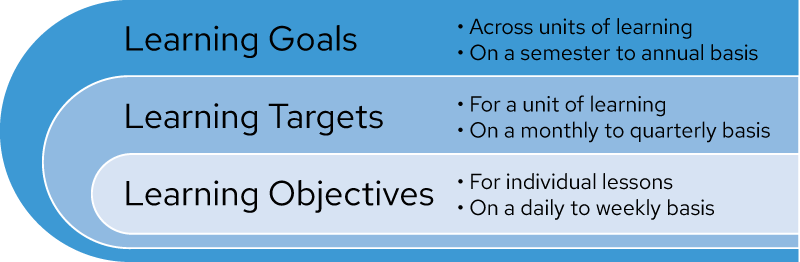
Figure 1: Learning Goals, Integrated Learning Targets and Integrated Learning Objectives
Unifying content and language for multilingual learners is a theoretical cornerstone and everyday instructional practice. WIDA also recognizes multimodalities and multilingualism, including translanguaging, as expressions of what multilingual learners can do. “In addition to the use of spoken and written language, students also communicate through gestures, facial expressions, images, equations, maps, symbols, diagrams, charts, videos, graphs, computer-mediated, and other means” (WIDA, 2020, p. 357). To optimize multilingual learners’ engagement in content-driven language learning, the third-grade team thinks about how it can
- Coordinate curricular design around students’ conceptual, language and (bi)literacy development.
- Pool information on multilingual learners’ linguistic, cultural and academic strengths.
- Encourage students to actively participate in interactive activities, tasks and projects.
Learning Goals
As part of the school’s ongoing professional learning, grade-level teams set clear attainable goals with students to drive learning. Language development and bilingual teachers, in partnership with other educators, meet with their multilingual learners to share assessment information (e.g., from WIDA Screener, WIDA ACCESS and annual achievement measures). Students and teachers then co-create annual, semester or quarterly learning goals, such as one for speaking: “I will keep a weekly oral science log from my discussions, readings and activities.”
Learning goals are global, often highlighting a language domain (e.g., Speaking) or mode (e.g., expressive). At pivotal times during the year, teachers and students update or expand their learning goals based on accumulated evidence from classroom and interim assessment. Using information from WIDA MODEL, WIDA Language Charts and student work samples, teachers can document students’ language growth over time.
Integrated Learning Targets
Curie school’s curriculum planning starts with a standards-referenced unit theme, topic or student-generated inquiry matched to available resources, including books, videos, podcasts, infographics or digital references. In co-creating each unit’s integrated learning targets, grade-level teams consider their multilingual learners’
- Oral language development
- (Bi)literacy development
- Linguistic and cultural influences, including translanguaging
- Home and community knowledge
- Multimodal preferences (e.g., visual, auditory, kinesthetic, graphic supports)
- Content-area knowledge and skills
With this understanding, the third-grade team dives into co-designing integrated learning targets referring to WIDA’s Language Expectations and the project’s question. Integrated learning targets generally emphasize a language dimension (e.g., discourse or sentence) within a Language Function. The third-grade project – producing a data display of temperatures from two familiar locations with a summary – is identical for all students. However, there are several multimodal pathways to accomplish it: graphically, orally and/or in writing. That’s where students have choices.
Integrated Learning Objectives
Integrated learning objectives capture a Language Feature within the selected Language Function (e.g., “Describe observations and/or data about a phenomenon,” in this instance, day-to-day temperature fluctuations). The teachers realize that integrated learning objectives in clear, student-friendly language complement integrated learning targets to foster student engagement and
- Promote mutual understanding and joint ownership between content and language teachers.
- Bring coherence to lessons by offering a unitary focus.
- Accentuate students’ languages, literacies and cultural richness.
- Legitimize multilingual multicultural representation in classrooms.
- Reinforce the codependence of content and language in conjunction with cultural insights and technological advances (Gottlieb, 2021).
Keeping the integrated learning objective and its paired standards in mind, each lesson scaffolds to the next one, building up to the final project. For this unit, third graders are invited to collect data (daytime and nighttime temperatures) in one or more languages and compare their findings with peers.
Examples illustrating the step-by-step process can be found in Deconstructing a Unit of Learning for Multilingual Learners: Sample Template. The week-long weather unit enlightens both teachers and students:
- With their families, the students connect weather patterns to familiar places and people.
- The third-grade team integrates standards-referenced learning targets and learning objectives, characterizing the fusion of content and language.
- Teachers come to realize the impact of multilingual learners’ contributions to curriculum, instruction and classroom assessment.
References
Gottlieb, M. (2021). Classroom assessment in multiple languages: A handbook for teachers. Corwin.
Gottlieb, M. (2016). Assessing English language learners: Bridges to equity (2nd Ed.). Corwin.
National Governors Association Center for Best Practices & Council of Chief State School Officers. (2010). Common Core State Standards. https://www.thecorestandards.org
NGSS Lead States. (2013). Next generation science standards: For states, by states. The National Academies Press. https://www.nextgenscience.org
WIDA. (2025). WIDA language charts: Tying WIDA ACCESS scores to classroom assessment. Board of Regents of the University of Wisconsin System.
WIDA. (2023). Marco de los estándares del desarrollo auténtico del lenguaje español de WIDA: Kínder al 12o grado. Junta de Regentes del Sistema de la Universidad de Wisconsin.
WIDA (2020). WIDA English language development standards framework, 2020 edition: Kindergarten–grade 12. Board of Regents of the University of Wisconsin System.
Author: Margo Gottlieb
About WIDA Snapshots
WIDA Snapshots offer short, approachable introductions that help educators put concepts into practice in their work with multilingual learners.