



This WIDA Snapshot offers an introduction to Collaboration, one of the six ABCs of Family and Community Engagement. The ABCs of Family and Community Engagement are six key considerations for educators who support multilingual learners and their families and communities.
Collaboration in action: Engaging with multilingual learners, families and communities
As you engage with multilingual learners, their families and their communities, it is essential to consider how to make collaboration an ongoing, reciprocal and accessible practice that fits your specific context. This WIDA Snapshot offers considerations and resources to support all educators, whether you are new to collaborating with families and communities or wish to strengthen collaborative practices in your setting.
Take a moment to engage with this brief introductory video, and use the guiding questions to reflect and deepen your knowledge about collaboration.
Introduction to Collaboration Transcript
Guiding Questions
- How have we collaborated with multilingual families and their communities to create a shared mission/vision? How have we collaborated to review and revise family engagement policies and practices and make decisions about curriculum and instruction, social-emotional learning, and so on? What else could we be doing?
- In what ways might we be overwhelming families with education jargon? How can we ensure communication and collaboration is reciprocal, family friendly, and in the languages our families prefer?
- How do we encourage social support networks and connections among multilingual families and their communities? Is it working?
Collaborating in community
Creating social support networks and connecting multilingual students and families with community resources exemplifies collaboration in action. How do you collaborate and create community in your setting? What else could you try? Engage with the “Juntos Es” videos to hear from families, students and educators about their experiences with Juntos, a youth development and family engagement community group. Use this resource, Collaborating in Community to Support Multilingual Learners and Their Families, to learn more about Juntos and explore examples from across the consortium that highlight ways to collaborate and engage with communities.
Juntos es ... multilingual learners and their families
Juntos es ... Multilingual Learners and Their Families Transcript
Juntos es ... educators
Juntos es ... Educators Transcript
Collaborating in the classroom
For many educators, collaborating with multilingual families regarding classroom instruction is an ongoing process that extends throughout the year. Natalie Lau-Chien, a WIDA Fellow, invites families to share their goals and expectations at the beginning of the year so she can apply their input to her ongoing classroom instruction. WIDA Fellow Yulia Akulshina-Prys and Betsy Lutch co-teach in a kindergarten classroom. They invite families to participate in learning centers several times throughout the year. Engage with the following video to learn from Natalie, Betsy and Yulia’s experiences and tips. Use the tool Collaborating in the Classroom All Year Long to gather some ideas you can try.
Collaborating in the Classroom Transcript
Collaborating in the district
A family leadership committee can help ensure the voices of multilingual families are represented in decision-making at the district level. Engage with the following two videos, featuring families and educators, to learn how the multilingual parent leadership committee at Miami-Dade County Public Schools has collaborated to inform system-level changes. Explore the tool Collaborating in the District: Starting and Sustaining a Multilingual Family Leadership Committee to gather ideas for your own context.
Parent voice
Parent Voice: Collaborating in the District Transcript
Educator voice
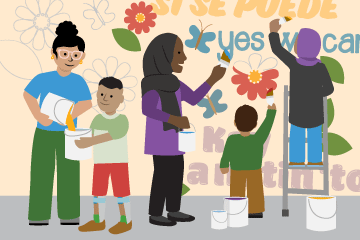
This illustration, representing collaboration, shows families, community members and educators painting a mural together. They are writing “Yes we can!” in the languages the families speak. Images of butterflies in the mural symbolize the right that all living beings have to move freely and show resilience, hope and solidarity.