



Understanding the New WIDA ACCESS for Kindergarten
By Mark Chapman, Hannah Haynes, Marcy Olson
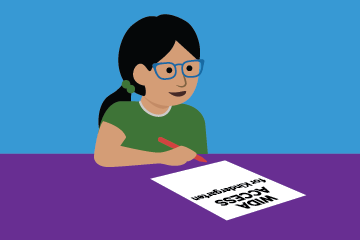
For many years, Kindergarten ACCESS for ELLs remained largely unchanged from its original release in 2008. Beginning in 2021, WIDA launched a multi-year effort to thoughtfully redesign the assessment. The result is the new WIDA ACCESS for Kindergarten that became available in the 2025-2026 school year.
This redesign was guided by updated standards, extensive educator input and rigorous research, all with the goal of creating a developmentally appropriate, meaningful assessment of English proficiency for multilingual learners in kindergarten.
Why We Redesigned Kindergarten ACCESS
There were two main drivers to the redesign. First, WIDA revised our standards with the release of the WIDA English Language Development (ELD) Standards Framework, 2020 Edition. The Standards introduced proficiency level descriptors (PLDs) for grade-level clusters. WIDA staff used those PLDs for multilingual learners in kindergarten to design and develop the new Kindergarten ACCESS.
The Standards told WIDA staff the linguistic expectations for the new test in each domain, but other information from educators was needed to guide aspects of the test redesign. So, WIDA conducted a large-scale research study to better understand educator perspectives on the original assessment. More than 3,000 educators across 27 states participated in a survey about the test, telling WIDA what we should keep and what we should change and improve. After studying the responses, WIDA researchers interviewed 22 additional educators through focus groups to explore these ideas in more depth. Findings from this research helped prioritize key design changes, including streamlining test materials and maintaining Kindergarten ACCESS as a one-to-one, paper-and-pencil assessment administered by a trained test administrator.
How Test Content Was Developed
All test content was co-developed by test developers at WIDA and the Center for Applied Linguistics (CAL), many of whom are former kindergarten educators, and current kindergarten educators who work with or have experience with multilingual kindergarten students.
The process began with a theme-generation meeting where educators proposed ideas for the assessment storyline. Two themed versions were developed and field tested; the assessment themed around a community garden performed better and became the new Kindergarten ACCESS.
There were multiple rounds of review throughout development, including checking for grade-level appropriateness and for bias and sensitivity issues. WIDA and CAL also conducted cognitive labs, pilot testing and field testing in schools across the WIDA Consortium, gathering detailed educator feedback that informed revisions at each stage.
Learn more:
Streamlining Materials and Grade-Level Appropriateness
The decision to streamline test materials, such as removing the activity board, came directly from the research project mentioned above. Simplifying test materials and the test administration process was a high priority for both educators and state education agency representatives who advise WIDA.
Ensuring test items are grade-level appropriate is essential in the creation of an assessment. Kindergarten educators worked with WIDA throughout development to review all content. Field testing data provides statistical evidence of appropriateness. During field testing, the assessment was administered to both kindergarten and first-grade multilingual learners. As expected, the data indicated that the test items were easy for first-grade students, but appropriately challenging for kindergarten students.
WIDA Standards and Test Difficulty
The WIDA ELD Standards Framework, 2020 Edition, introduced proficiency level descriptors (PLDs) for grade-level clusters. The Kindergarten PLDs informed the design and development of the new Kindergarten ACCESS. Compared to the previous standards, expectations for student language development are higher in the 2020 Edition, meaning the language assessed on the new test is more complex.
The new Kindergarten ACCESS measures many of the same kinds of language skills as the original assessment, for example students’ ability to understand spoken and written English at the word and sentence levels. The new assessment starts from slightly higher language expectations, and its most challenging items assess more complex language use.
Importantly, this does not mean that the test is harder for students. During field testing, students took both the original and new version of Kindergarten ACCESS. This allowed WIDA to statistically calibrate the difficulty of new items to the original test. Items that were too difficult or didn’t perform as intended were removed.
Key Takeaways
The new Kindergarten ACCESS reflects years of collaboration, research and educator expertise. Thank you to all the students and educators who were involved in this important work – WIDA and CAL could not have done it without you!
To support educators, WIDA created the WIDA ACCESS for Kindergarten: Administration and Scoring training course, featuring anchor samples, scoring practice and videos of real administration scenarios. You can access that course in the WIDA Secure Portal. WIDA and CAL also developed a new Low Vision Script accommodation, expanding access for students with low vision.

Connect with WIDA
Learn about the latest resources, exchange ideas and engage in discussion.


